10 Movies From 1948 That Are Now Considered Classics


Luc is also an avid producer of video essays and looks forward to expanding his writing career. When not writing, he can be found hiking, playing Dungeons & Dragons, hanging out with his cats, and doing deep dives on whatever topic happens to have captured his interest that week.
The late 1940s marked a moment of extraordinary creativity in global cinema, as filmmakers grappled with the emotional aftermath of World War II. In 1948, directors across Hollywood and Europe produced films that more boldly explored moral ambiguity and psychological depth.
The result was a strong slate of classics that hold up today. The titles below are well-crafted, some of them even including some technical innovations. The best also hit hard thematically, capturing something essential about human nature.
10 'The Naked City' (1948)

"There are eight million stories in the naked city. This has been one of them." The Naked City is a crime film from the great Jules Dassin, director of the iconic capers Rififi and Topkapi. This one is a procedural focusing on a police investigation into the murder of a young model in New York. Detectives piece together clues through interviews and surveillance. The main cop is played by Going My Way's Barry Fitzgerald. While that setup isn't especially original, the movie does stand out with its mood and aesthetic.
It was shot on-location and uses real environments, giving it an authenticity and immediacy that most 1940s films lack. The cinematography is naturalistic and documentary-like, drawing heavily on Italian neorealism and the work of photographer Weegee. It was generally praised as the strongest element of the film, and took home that year's Oscar for Best Cinematography.
9 'Key Largo' (1948)

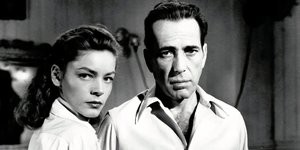
"You talk too much." Key Largo brings together a drifter (Humphrey Bogart), a hotel owner (Lionel Barrymore), and a notorious gangster (Edward G. Robinson) as they ride out a hurricane in a Florida Keys hotel. But the storm outside mirrors is soon dwarfed by the conflict brewing within, as tensions mount and loyalties are tested. This is a character-driven film, powered by electric performances across the board.
There's a particularly tense, compelling dynamic between Bogart and Robinson, though the best performance overall belongs to Claire Trevor as the alcoholic former nightclub singer, a role for which she won the Best Supporting Actress Oscar. The direction is sturdy, too, courtesy of the legendary John Huston, the brains behind classics like The Maltese Falcon and The Treasure of the Sierra Madre. He keeps the tension coiled throughout, turning the Hotel Largo into a nail-biting pressure cooker of combustible personalities.
8 'Letter from an Unknown Woman' (1948)

"By the time you read this, I may be dead." Letter from an Unknown Woman is one of the defining projects from filmmaker Max Ophüls. It tells the story of a concert pianist (Louis Jourdan) who receives a letter from a woman (Joan Fontaine) recounting her lifelong, unrequited love for him. Through her memories, the film reveals the depth of her devotion and the ways in which their lives intersected without his full awareness. While obviously a little dated in some ways, Letter from an Unknown Woman is still a great showcase for Ophüls' mastery of romantic melancholy.
Known for his "flowing" camera, he uses elaborate, seamless tracking shots and long takes to give the movie a dreamlike quality. This visual style elevates the sentimental story into something a little more profound and sophisticated. He's assisted by a fantastic, layered performance by Fontaine. She convincingly plays the character across several stages of life.
7 'Germany Year Zero' (1948)

"We must start again." Germany, Year Zero is a landmark work of Italian neorealism. Directed by Roberto Rossellini, it focuses on a young boy (Edmund Moeschke) struggling to survive in the ruins of postwar Berlin, caring for his family while navigating the devastated city. Through him, the movie presents a stark portrait of life amid destruction. Rossellini delves deep into themes of moral confusion and innocence, showing us many sides to a society grappling with the consequences of conflict.
Matching this subject matter, the film's style is raw and realist, achieved through on-location shooting and nonprofessional actors. Filmed in the actual ruins of Berlin in 1947, the city’s devastation serves as more than a backdrop. It's a central "character" that reflects the moral and social collapse of the people living within it. Edmund, especially, stands as a symbol for Germany itself at that moment in time: starving, corrupted by ideology, and ultimately facing its own annihilation.
6 'Hamlet' (1948)

"To be, or not to be." Laurence Olivier both directs and stars in this powerful adaptation of Hamlet. He ably brings the famous tragedy to the screen, with a particular focus on the prince’s psychological struggle. Crucially, Olivier moved away from the "filmed stage play" feel by using a prowling, restless camera and deep-focus photography. The camera often acts as a character, exploring the cavernous, shadowy halls of Elsinore. In other words, this was an early instance of a Shakespeare adaptation making full use of cinema as a medium.
This comes through clearly in the cinematography. Filmed in stark black-and-white, the movie has a moody, Gothic atmosphere influenced by film noir and German expressionism. This visual style helps convey the psychological decay and isolation of the characters. For his efforts, Olivier took home that year's Best Picture Oscar as well as the prize for Best Actor.
5 'Bicycle Thieves' (1948)

"When you need a bicycle, you don’t ask questions." While Germany, Year Zero is powerful, Bicycle Thieves surpasses it in terms of emotion and impact. It's perhaps the most famous of all Italian neorealist films. The story is simple but devastating: Antonio (Lamberto Maggiorani), a working-class father in postwar Rome depends on a bicycle for his new job, only for it to be stolen on his first day. Desperate to recover it, he searches the city with his young son Bruno (Enzo Staiola), their journey becoming a quiet odyssey through poverty, hope, and disappointment.
Antonio’s growing desperation and Bruno’s innocent perspective create a poignant emotional dynamic that anchors the story. Their tale feels deeply authentic, in large part because the actors were untrained and because all the locations were real. The storytelling is honest and unvarnished. This approach was deeply influential, inspiring countless filmmakers to follow, from Satyajit Ray to Ken Loach and Jafar Panahi.
4 'The Treasure of the Sierra Madre' (1948)

"Badges? We ain’t got no badges." John Huston delivered not one but two bangers in 1948. The Treasure of the Sierra Madre is the superior one, one of the finest neo-Westerns of its day. The plot follows two down-on-their-luck Americans (Humphrey Bogart and Tim Holt) who join forces with an experienced prospector (Walter Huston, the director's father) to search for gold in the Mexican mountains. Their fortunes soon improve, but suspicion and greed begin to erode the trust between them, transforming the expedition into a psychological battle as dangerous as the wilderness itself.
The writing and acting are phenomenal here, with Bogart making a particular impression as a man gradually consumed by paranoia. All this adds up to a remarkable character study and cautionary tale about how the love of money can corrode the soul. In this regard, The Treasure of the Sierra Madre influenced subsequent masterpieces like There Will Be Blood and Breaking Bad.
3 'The Red Shoes' (1948)

"Why do you want to dance?" The Red Shoes is one of the very best films by Michael Powell and Emeric Pressburger, the directing duo better known as The Archers. It tells the story of a young ballerina (Moira Shearer) whose devotion to her art places her at odds with personal relationships and societal expectations. As she rises within a prestigious ballet company, the tension between creative ambition and emotional fulfillment becomes increasingly difficult to reconcile.
The film dazzles with its bold visual style, boasting lush cinematography and remarkable choreography. The vibrant, saturated colors and luminous lighting create a surreal, storybook atmosphere. Its most powerful scene is the 17-minute ballet centerpiece, which is remarkably well done. The sequence uses tricks like slow motion, jump cuts, and shifting sets that wouldn't be possible on a real stage, putting the audience directly inside the dancer’s mind. Here, The Archers synchronize music, color, and movement like a symphony.
2 'Red River' (1948)

"This is my herd!" Red River chronicles a cattle drive led by a determined rancher (John Wayne) whose authoritarian leadership creates tension with his adopted son (Montgomery Clift). They journey across the American frontier, but conflicts both external and internal threaten to sabotage their mission. Director Howard Hawks expands this setup into a character-driven drama, one with way more psychological depth than most Westerns of the time.
Indeed, Wayne, in particular, turns in one of his most complex performances here. He's a strong leader, but that steadfastness also means he can be stubborn, unyielding, and even callous. In his worst moments, he teers on the brink of tyranny and madness. This was a very interesting role for the star, powerfully subverting his usual heroic Western persona. The more sensitive performance from Clift provides the perfect foil. This conflict between the authoritarian father and the rebellious son gives the movie an almost Shakespearean weight.
1 'Rope' (1948)

"The perfect murder is not a difficult thing to accomplish." Alfred Hitchcock’s Rope unfolds in real time within a Manhattan apartment, where two young men (John Dall and Farley Granger) commit murder and host a dinner party while hiding the victim’s body in plain sight. Guests begin arriving, including a former teacher (James Stewart) who begins to suspect the truth, cuing ever-ratcheting suspense and a series of psychological games. The confined setting becomes a pressure cooker of anxiety.
While the plot is tense, it's the direction and aesthetics that really elevate the film. For instance, to mimic the real-time flow of a stage play, Hitchcock filmed in long takes of up to 10 minutes (the maximum a camera magazine could hold). He also hid cuts by panning into dark surfaces or behind actors' backs, creating a seamless, claustrophobic experience. He also marvelously weaponizes audience information. Much of the suspense comes from the audience knowing something the characters don't.

- Release Date
- August 26, 1948
- Runtime
- 81 minutes
- Director
- Alfred Hitchcock
- Writers
- Arthur Laurents, Ben Hecht, Hume Cronyn
Cast
-
 James Stewart
 -
John Dall






💬 No comments yet. Be the first to share your thoughts!