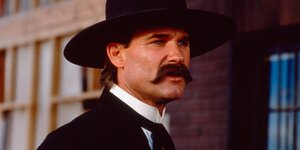
10 Western Masterpieces Better Than 'Tombstone'


There's no denying that Tombstone is a Western classic that deserves high praise. Between its powerful performances, masterful script, and cinematic quality, it's a picture that has set the standard for what modern horse operas ought to be. But just because Tombstone is so beloved by audiences everywhere doesn't mean that there aren't a great deal of Westerns that are better.
Of course, "better" is somewhat subjective, but if any features can surpass Tombstone as Western masterpieces, it's the entries on this list. From John Wayne classics to Clint Eastwood-style Spaghetti Westerns, these are the horse operas that you won't want to miss the next time your Tombstone craving leaves you wanting more. So, without further ado, these are the Old West tales that need your full attention.
'Butch Cassidy and the Sundance Kid' (1969)

Everyone who has been around the Western space long enough knows that Butch Cassidy and the Sundance Kid is a masterpiece. As the first (and best) collaboration between Robert Redford and Paul Newman, this tale of daring outlaws on the run from their pursuers is unlike most of the shoot-'em-ups of its day. Emphasizing the buddy dynamic between Butch and Sundance, this 1969 Western classic is a powerful display of New Hollywood in action.
With stellar performances from its two leads, Butch Cassidy and the Sundance Kid offers audiences a different glimpse of the outlaw life, one full of romance and optimism yet ultimately doomed. Still, it's the chemistry between Newman and Redford that really makes it shine brighter than Tombstone. Even though the "Raindrops Keep Fallin'" scene feels maybe a bit out of place, we can't help but love it.
'The Man Who Shot Liberty Valance' (1962)

A powerful collaboration between director John Ford and the uniquely effective duo of James Stewart and John Wayne, The Man Who Shot Liberty Valance is a Western classic steeped in mythic tradition. Although not his final big-screen Western, it feels as if it could have been Ford's send-off to the genre. As Stewart's unassuming Rance Stoddard stands up to the bully that is Liberty Valance (Lee Marvin), Wayne's Tom Doniphan steps in to give his romantic rival a hand. But this picture is about so much more than that.
At its core, The Man Who Shot Liberty Valance is about how Western myths were made and how they propagate long after those they're based on have died. Just as the film symbolically signifies the end of an era for the Western, it's also a meditation on the fading nature of the Old West as civilization comes through. Stewart and Wayne play off each other marvelously here, making us wish that they made more films together.
'Shane' (1953)

Although there's an argument to be made that Shane has gotten more popular in recent years due to a certain Marvel Comics-based superhero film, one only has to watch the first few minutes of the 1953 picture once to remember that it's truly a Western masterpiece. Alan Ladd stars as the titular gunfighter, who strolls into the middle of a Lincoln County War-style conflict at the foot of the Tetons. As one of the only men bold enough to stand and fight, Shane is the archetypal Western hero we can't get enough of.
Although the action isn't as stylish as what you might see in Tombstone, Shane pulls no punches when it comes to '50s Western brawls. The film is not only visually stunning, but it's a breathtaking tale that solidifies the Western myth on the big screen. Even over 70 years later, Shane remains a perfect reminder of everything the genre should be.
'High Noon' (1952)

In under 90 minutes, High Noon manages to do what most blockbusters these days struggle to: keep the audience's attention through dramatic tension alone. In an Oscar-winning role, Gary Cooper stars as U.S. Marshal Will Kane, a man who stands alone to protect his New Mexican town from the impending return of a notorious outlaw who wants him dead. With no one to turn to, the lawman proves to be more than worth his mettle.
Cooper is a rock here, playing Kane as a balanced and driven hero who wrestles with the failure of those around him to come to his aid. While folks have argued as to the exact meaning of the picture over the years, with both sides of the political aisle claiming it as their own, it has even helped inspire revolution in other countries. High Noon is a great unifier when it comes to the Western — unless you're John Wayne, that is.
'Stagecoach' (1939)

Although John Ford had been in the Western business for some time and Wayne was already a star in the making, Stagecoach was the film that truly ignited their career. Revolutionizing the Western by ushering it away from B-picture status and into the public eye as a genre worthy of its salt, the Duke stars as the Ringo Kid, who, along with an assortment of eclectic passengers, fights off a band of Apaches as they head to Lordsburg.
Wayne has arguably the coolest Western intro ever, and Ford effortlessly elevates the genre with dramatic tension and complex characters. There's a reason Stagecoach joins Tombstone on our list of the most timeless Westerns out there, but where the latter leans into blockbuster action, the former's tight script and runtime push it into the spotlight. There's just nothing like that Monument Valley landscape.
'The Magnificent Seven' (1960)

When a small village in Mexico is attacked by an array of bandits, who else can the helpless villagers call but a band of gunslingers? The Magnificent Seven continues to live up to its name all these years later — and for good reason. Immensely popular, it has inspired several sequels, remakes, and even television adaptations, despite the 1960 film itself being a remake of Seven Samurai. A Western with the cool factor that is Steve McQueen, it rivals Tombstone in action alone.
Directed by John Sturges, The Magnificent Seven features a stellar cast and tells an iconic tale of men who would stand against lawlessness despite the lack of a badge. Isn't that what the genre is really all about? With a great mixture of action, humor, character work, and clever suspense, there's a reason why it is one of the most rewatchable Westerns in the entire canon.
'The Gunfighter' (1950)

Certainly one of the most underrated picks on this list, The Gunfighter is the type of "thinking man's Western" that reminds audiences that the genre doesn't have to just be full of quick gunplay and drawn-out horseback rides. Gregory Peck stars as gunman Jimmy Ringo, a man who is on the run from his growing reputation, hoping to retire. With a psychologically rich performance from Peck, what this film lacks in Tombstone-style action, it more than makes up for with its complex leading man.
Like some of the other pictures on this list, part of what makes The Gunfighter special is the way that it examines the truth behind the legends that are still propagated across the American West. As Ringo seeks to remake himself, he realizes that he cannot fully outrun his past, nor will the myth of the title hero fade so easily.
'The Good, the Bad and the Ugly' (1966)

Although any one of Sergio Leone's three Dollars Trilogy installments could probably make their way onto this list, there's a reason that the epic scale of The Good, the Bad and the Ugly continues to delight viewers. The combined efforts of Clint Eastwood, Lee Van Cleef, and Eli Wallach deliver with profound impact here in this Spaghetti Western classic, and the rousing score from Ennio Morricone does the already impressive visuals even more favors. Plus, The Man With No Name has never been cooler.
Maybe you love it for the famous Mexican standoff sequence (that truly generates tension like no Western before or since) or because you can't get enough of Eastwood's most recognizable hero. Whatever the case, The Good, the Bad and the Ugly is a cinematic wonder. It may not be as tight as A Fistful of Dollars or even as psychologically rich as For a Few Dollars More, but the film's epic scope and scale more than make up for it.
'The Searchers' (1956)
Arguably the best movie that either John Ford or John Wayne ever made (and even the Duke thought so), The Searchers takes a classic story of a man on a mission to save his kin and turns it into a revenge-filled, prejudice-challenging drama that reaches for the cinematic heavens. As Wayne's Ethan Edwards hops on the trail of his missing niece, taken by Comanches, he wanders the Old West for years in hopes of finding her — but whether he wishes to find her dead or alive is up for debate.
As one of the greatest Westerns ever made (bar almost none), The Searchers best showcases Wayne's acting ability. Although he often played the "stock John Wayne" cowboy that then became his entire public persona, Ethan Edwards is a far more complicated man worth digging deeper into. The Duke outdoes himself here, and though he'd play fine roles after (even winning an Oscar for True Grit), Edwards is the role that should have earned him that Academy Award.
'Unforgiven' (1992)

Speaking of awards, while not the first Western of the '90s to win Best Picture at the Oscars, Unforgiven is arguably the only one of the two that is superior to Tombstone. Even if you prefer to revisit the Old West antics of Wyatt Earp and his brothers, this Clint Eastwood-made picture is undoubtedly the more dramatic, sobering take on the historical period. When former gunslinger William Munny (Eastwood) finds himself in hard times, he returns to the world of gunslinging one final time.
Eastwood's ultimate sendoff to the Western genre, Unforgiven, is, well, unforgiving in its approach to the American West. Like the best films of its kind, it analyzes the myths and legends surrounding the period, but only to deconstruct and subvert them with historical truths and genre-shattering revelations. Not only is it easily the best movie Eastwood ever made, but it's one of the most important Westerns, too.

Unforgiven
- Release Date
- August 7, 1992
- Cast
- Clint Eastwood, Gene Hackman, Morgan Freeman, Richard Harris, Jaimz Woolvett, Saul Rubinek, Frances Fisher, Anna Thomson, David Mucci, Rob Campbell, Anthony James, Tara Frederick, Beverley Elliott, Liisa Repo-Martell, Josie Smith, Shane Thomas Meier, Aline Levasseur, Cherrilene Cardinal, Robert Koons, Ron White, Mina E. Mina, Henry Kope, Jeremy Ratchford, John Pyper-Ferguson
- Runtime
- 130 Mins
- Director
- Clint Eastwood
- Writers
- David Webb Peoples



💬 No comments yet. Be the first to share your thoughts!