
20 Box Office Flops That Nobody Saw Coming


In the world of filmmaking, success at the box office is never a guaranteed outcome, even when all the right elements seem to be in place. A movie can boast an intriguing premise, a talented cast, and high-quality direction, yet still fail to resonate with audiences when it hits theaters. These films often have promising prospects—whether they’re from seasoned directors or feature prominent actors—but for reasons both subtle and significant, they miss the mark commercially. Despite their potential, they become cautionary tales of how unpredictable audience tastes and market conditions can be.
The reasons behind these unexpected box office failures are often more complex than they seem. Timing can play a massive role. Marketing may also fail to clearly communicate a film’s appeal or generate the excitement needed to draw in a wide audience. In other cases, films that seem tailor-made for success fail to click with viewers due to tonal mismatches or even just an audience not quite ready for something different. This article takes a look at some of the major movies that should have been easy home runs, but instead, they struck out.
20 'The LEGO Movie 2: The Second Part' (2019)

After the massive success of The LEGO Movie, it was no surprise that Warner Bros. announced a sequel was in the works, but The LEGO Movie 2: The Second Part had several industry factors working against it that ultimately led to it failing at the box office. Initially, no one expected The LEGO Movie to be as big a hit as it was, but like every major studio that finds success, Warner Bros. became its own worst enemy by capitalizing too much on the franchise, essentially draining it of its original magic and general appeal.
Between the release of the movie and the sequel, Warner Bros. overloaded audiences with spin-offs such as The LEGO Batman Movie and The LEGO Ninjago Movie that lacked originality and led to franchise fatigue. By the time the sequel arrived five years later, the overall concept didn't feel fresh anymore, which is the main reason why the film flopped. The extensive gap between the first and second movies also dulled the overall hype, and its weak marketing efforts essentially put the final nail in the coffin for The LEGO Movie 2: The Second Part. —Andrea Ciriaco
19 'Treasure Planet' (2002)

For decades, Walt Disney Studios reigned as one of the top innovative studios in the art of animation and rarely failed to entertain audiences of all ages, but its 2002 movie, Treasure Planet, was a box office flop that no one ever saw coming. Similar to The LEGO Movie 2, Treasure Planet had creative ambition and appealed to most audiences, but its timing and lack of marketing are what ultimately sealed its fate.
Treasure Planet was released during Thanksgiving, which the majority of movie fans know is a critical time of year for movies, but when you have a movie coming out the same weekend as long-awaited sequels like Harry Potter and the Chamber of Secrets and Die Another Day, it makes the competition even more intense. The film's outer space setting also proved to be detrimental, as the marketing team failed to communicate the film's overall concept, causing confusion among the public who weren't sure what the movie was exactly about. —Andrea Ciriaco
18 'Alexander' (2004)

Oliver Stone's 2004 epic historical drama, Alexander, looked to be a guaranteed hit on paper, but despite its star-studded cast, notable director, and grand spectacle, it stumbled to reach the finish line at the box office, especially in the United States. After Ridley Scott's infamous Gladiator, audiences were expecting Alexander to fall into the same realm and be an action-packed movie with emotional weight. Instead, the movie had a more character-driven story and a heavy focus on Alexander's psychological state and relationships, leaving little to be desired.
While the initial negative reviews by word of mouth hurt the movie before it even graced the silver screen, the main issue audiences had with Alexander was its portrayal of its historical titular character, played by Colin Farrell, which became a major distraction from the film itself and left audiences divided. The film's lengthy runtime of three hours also didn't help its cause, as it resulted in very few daily showings in the majority of theaters and felt like a long-term commitment that many moviegoers had no interest in making. —Andrea Ciriaco
17 'Fight Club' (1999)

David Fincher's Fight Club is now an iconic classic, but when it was originally released, it seriously underperformed at the box office and was widely believed to be a disappointment despite its gritty premise and prolific stars. Based on Chuck Palahniuk's 1996 novel of the same name, the studio promoted Fight Club as a macho action movie about underground fighting, but audiences got something less of a straightforward muscle flick and more of a dark satire about consumerism and masculinity, catching them completely off guard.
Aside from its mismatched marketing, the film's violent nature and aggressive themes sparked serious backlash from both critics and audiences, who felt that it glorified brutality and violence. The film's final flaw was its dark and disturbing tone and lack of a clear hero, which made its overall message difficult for audiences to decipher. Between the film's rush to judgment and moral ambiguity, it's understandable why Fight Club bombed at the box office, but over time, it has been reevaluated and has since become a beloved cult classic. —Andrea Ciriaco
16 'Elio' (2025)

Elio follows the story of an eleven-year-old boy, Elio Solís (voiced by Yonas Kibreab), who is deeply obsessed with space and aliens that he dreams of meeting. One day, he is accidentally beamed into space and mistaken for Earth’s official ambassador by a group of extraterrestrials. He discovers the Communiverse, a place where aliens share knowledge, and must prevent a crisis with one of the alien warlords.
Critics generally responded favorably to Pixar's animated adventure. It received solid reviews praising its charm and themes, but the film underperformed at the box office, grossing about $154 million worldwide, making it one of Pixar’s lowest theatrical earners. It faced strong competition from the summer's breakout hits like the live-action versions of Lilo & Stitch and How to Train Your Dragon, which sucked up its potential audiences. Many attributed that the audiences have already been accustomed to seeing Pixar movies on Disney+ since the pandemic times. Even though fans expected the film to catch fire later on like Elemental, Elio got beamed out of the box office charts faster than expected.
15 'Blade Runner 2049' (2017)

Following in the footsteps of its predecessor, director Denis Villeneuve's follow-up to the iconic Blade Runner did not receive much love from the box office. Blade Runner 2049's attempt at being a worthy sequel to one of the most influential sci-fi films ever made was not met with immediate acclaim and popularity, instead resulting in a loss of about $80 million.
Starring Ryan Gosling and Harrison Ford, the sci-fi film had glowing early reviews and a devoted fanbase eager to return to the neon-lit dystopia — it seemed like a sure winner. That said, its meditative approach and stunning visuals have slowly earned it respect from fans and critics alike, proving that box office numbers don't always reflect a film's long-term legacy.
14 'The Shawshank Redemption' (1994)

Adapted from Stephen King’s novella, The Shawshank Redemption tells the story of Andy Dufresne (Tim Robbins), a banker sentenced to life in Shawshank prison for the murder of his wife and her lover—a crime he insists he didn’t commit. Over the decades, Andy forms a close bond with Ellis "Red" Redding (Morgan Freeman), a fellow inmate and the prison’s go-to man for smuggled goods. The film explores themes of hope, resilience, and redemption, set against the grim backdrop of prison. Despite its eventual status as one of the greatest films of all time, The Shawshank Redemption was a commercial disappointment upon release.
The film’s initial failure at the box office was due to its release in a competitive season, going up against hits like Pulp Fiction and Forrest Gump. Additionally, the prison drama genre lacked mainstream appeal, and the title itself didn’t convey much about the film's plot; even Robbins and Freeman blamed that. This was a surprise because when the film was tested, the scores were high, leading the studios to be optimistic about the prospects of the movie. However, The Shawshank Redemption found immense success in home video sales and frequent TV airings, becoming a timeless classic celebrated by generations. Its failure was a stepping stone to its ultimate legacy.
13 'The Quick and the Dead' (1995)

This revisionist Western, directed by Sam Raimi, follows Ellen (Sharon Stone), a mysterious gunslinger who rides into a corrupt frontier town to compete in a high-stakes quick-draw tournament. The contest, organized by the ruthless mayor and former outlaw John Herod (Gene Hackman), pits the best sharpshooters against one another in deadly duels. Driven by her motive to avenge her father’s death at Herod’s hands, she enters the deadly tournament. The film also stars Russell Crowe and Leonardo DiCaprio, early in their Hollywood careers.
Raimi had just come off from his successful Evil Dead films, and Stone was still riding the success of Basic Instinct, so the stars should have aligned for the success of the film. Despite its unique flair and star-studded lineup, The Quick and the Dead failed to connect with audiences, earning just $18 million against its $35 million budget. Its underperformance stemmed from its main genre as Westerns were largely out of fashion in the mid-1990s, which hurt its appeal. Additionally, its unique tone, which oscillated between campy action and gritty drama, also didn't help good word of mouth to spread. However, the film has since garnered a cult following and, over time, it’s come to be seen as an underrated gem within the Western genre.
12 'Last Action Hero' (1993)

Last Action Hero is a meta action-comedy that follows a movie-obsessed kid, Danny Madigan (Austin O'Brien), who magically enters the cinematic world of his favorite action star, Jack Slater (Arnold Schwarzenegger), in his Jack Slater universe. His playful adventure turns serious as Mr. Benedict (Charles Dance), a ruthless villain from Jack Slater, escapes to the real world and starts wreaking havoc.
Though expected to be a summer blockbuster, Last Action Hero struggled with its box office performance, grossing about $130 million worldwide. Coming off a string of hits like Total Recall, Terminator 2, and Kindergarten Cop, Schwarzenegger was one of Hollywood's biggest moneymakers at the time. Last Action Hero broke his streak as it faced heavy competition from Jurassic Park, and its plot was probably too ahead of its time as meta movies were not mainstream yet. It resulted in mismarketing as the film was advertised as a straight action film. Since then, the film has developed a cult following citing its self-aware tone and fun take on the action genre.
11 'Ali' (2001)
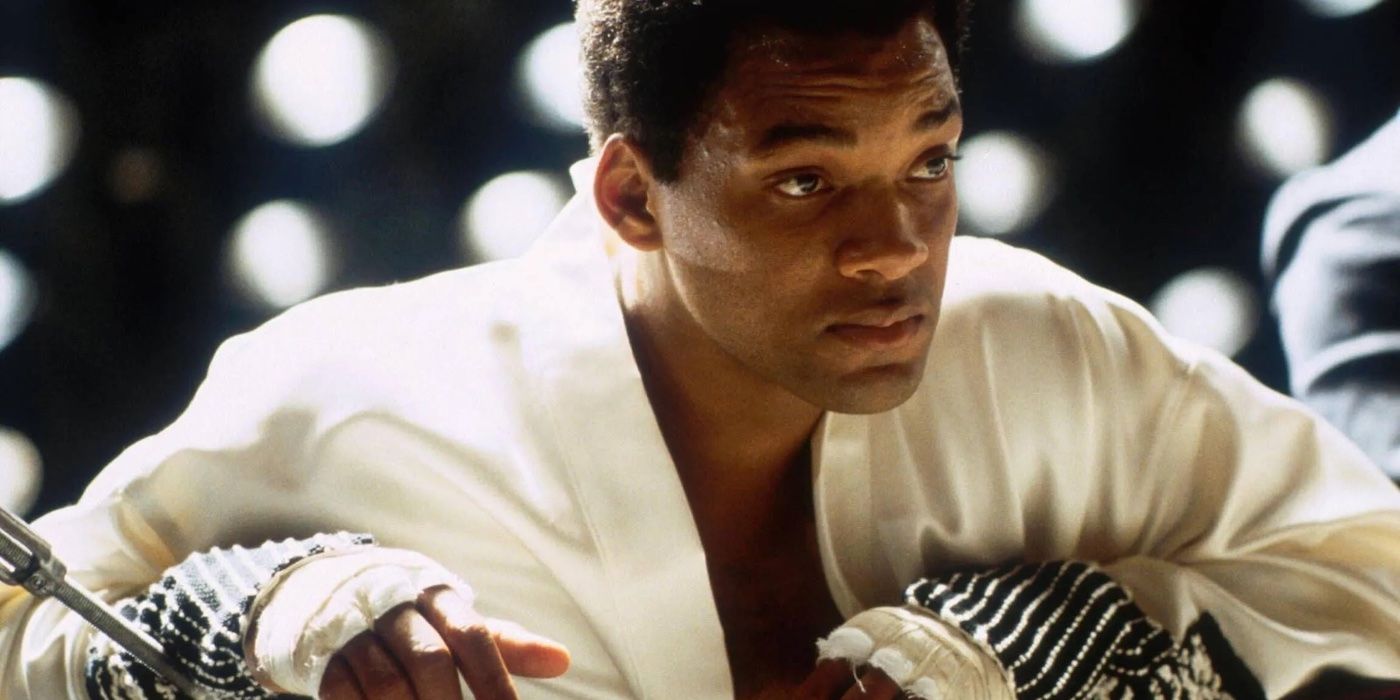
Michael Mann’s Ali chronicles the life and career of Muhammad Ali (Will Smith), focusing on his transformative decade from 1964 to 1974. The film follows Ali's rise to global fame, his controversial decision to refuse the Vietnam War draft, and his eventual comeback after being stripped of his title. The film highlighted iconic moments such as his legendary fights against Sonny Liston, Joe Frazier, and George Foreman, with the "Rumble in the Jungle" as the climax.
Despite critical acclaim for its performances and historical depth, Ali underperformed at the box office. Its lengthy runtime was one of the reasons, but it also suffered from a packed Christmas release date, which included the box office smash, The Lord of the Rings: The Fellowship of the Ring. Additionally, the film’s introspective tone didn’t match the expectations of those anticipating a more action-packed sports drama. Though it didn’t achieve financial success, Ali has since been recognized as a solid, ambitious biopic, with many appreciating Smith’s Oscar-nominated, powerful depiction of the boxing legend.















💬 No comments yet. Be the first to share your thoughts!