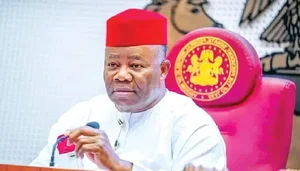
We’re in the Senate to Serve, Not to Make Money – Akpabio Declares
Senate President Godswill Akpabio has emphasized that Nigerian lawmakers are not in the Senate to enrich themselves but to make meaningful sacrifices for the benefit of future generations.
Akpabio made the statement on the Senate floor during deliberations on the general principles of a Bill to amend the Electricity Act, 2023.
The proposed amendment aims to tackle pressing challenges in Nigeria’s electricity sector. It seeks to improve policy and regulatory coordination, enhance funding across the sector, safeguard critical power infrastructure, promote industrial harmony, and clarify transitional processes—especially the handover of certain electricity-related responsibilities from the Nigerian Electricity Regulatory Commission (NERC) to state governments.
Sponsored by Senator Enyinnaya Abaribe (APGA, Abia South), who chairs the Senate Committee on Power, the bill—SB. 862—also aims to redefine how host communities engage with licensees operating in Nigeria’s electricity supply industry.
During his remarks, Akpabio stressed the central role electricity plays in national development.
“Without electricity, there can be no industrial growth in this country. People often think we’re in the Senate to make money, not realizing we are here to make sacrifices for the good of future generations,” he said during plenary on Tuesday.
Once the bill is amended, passed, and signed into law, it will help streamline the transfer of intrastate electricity matters from federal to state control, particularly concerning the operation of the national grid and overlapping jurisdictional issues.
The bill successfully passed its second reading and has been referred to the Senate Committee on Power for further legislative work, with a six-week deadline to report back.
In his lead debate, Senator Abaribe explained that the Electricity Act (Amendment) Bill, 2025, which was first read on June 25, 2025, is intended to address significant gaps identified since the implementation of the 2023 Act.
According to Abaribe, the bill will:
- Enhance coordination between federal and state governments to prevent legal conflicts,
- Strengthen financial support in the face of ongoing sector-wide debt issues,
- Criminalize vandalism of critical power infrastructure amid increasing sabotage,
- Improve industrial relations by balancing labor rights in essential service sectors,
- Clarify transitional arrangements for the decentralization of electricity regulation in Nigeria














💬 No comments yet. Be the first to share your thoughts!